Tuesday, April 21, 2015

Interview with John L (Blog #4 for LS 581)

This blog entry is for a course at the University of Alabama that discusses people with disabilities, impairments and the aging society in regards to technology. This is an interview I did with John L on Sunday, April 19, 2015.  

John told me that he was born in the 1960s as a preemie. He wasn’t sure if the medication used during that time caused it his hearing impairement. He went on to saying that hearing impairments and deafness does run on his mother side of the family (some of his cousins and an uncle, his grandmother was born deaf, grandfather qualified for cochlear surgery [although declined]) and his mother is severely hearing impaired. His specific kind of hearing loss is a high frequency hearing loss which means that sounds like watch alarms, whispers, etc., he cannot hear at all. The use of American Sign Language (ASL) was a necessary second language growing up. He told me that he learned it that way a child learns Spanish in a Hispanic household, it is kind of a homegrown “dialect” of formal ASL.  

He went through school well enough, although he failed his first hearing test in 2nd grade. He did admit that his delinquent behavior in school could have been linked to not being able to hear well in school, but he felt like it wasn’t a huge detriment until his late teens when he tried to enlist in the armed services. He failed it outright. At 18, he wore his first hearing aide, which was one that went inside. Today he uses a very powerful over the ear aide to be able to hear people, although he needs to read lips. He is unable to hear without them, and he told me that as he gets closer to 50s the decline in his hearing has progressed. 

Meeting John, you would never figure he was deaf until you realized he was staring at you so intently to read your lips. He doesn’t “sound” deaf although if you are more of a soft spoken individual or mumbles or speaks in a heavy dialect, he will ask you to repeat what you say. He said that often times, people shout and slowly pronounce every single word once they realize he is deaf. It has affected him in securing steady work and he backed up that statement by saying that the unemployment rate for a deaf individual ranges from 40% - 50%. He said that he was glad to have made it through his school years under the guise of “normal”. He is very well aware how cruel kids are to those with disabilities. 
Within the last 10-15 years, John has embraced technology to the fullest. He never was fond of the TTD/TTY relay systems. He said he never liked the idea of someone “listening” in on a private conversation. 

When I asked him how else technology has helped him outside of “text messaging” he said this, “…Interesting question. For me it allows expression through writing. It allows me to have closer mental relationships and companionships with people which I wouldn’t have otherwise. It allows me to practice videos with lyrics for my band pursuits (he is an ex drummer and singer for various local metal bands), and I’ve met some really wonderful and unique people via the internet, some of which I’m honored to call family. As far as romantic liaisons…you’ll just have to find me and find out for yourself.”

Technology has also allowed him to fulfil the dream of publishing his first children’s book, The Adventures of Itty Bitty and Lulu which can be found on Amazon at http://www.amazon.com/Adventures-Itty-Bitty-Lulu-Book-ebook/dp/B00NWSUYFI/ref=sr_1_1?ie=UTF8&qid=1413829832&sr=8-1&keywords=adventures+of+itty+bitty+and+lulu


Tuesday, February 17, 2015

Book Review: "How to Age" by Anne Karpf

This blog post is to satisfy an assignment for LS 581 Universal Design for Information Technologies which is a course that focuses on aging, ageism, and disability in correlation to technology.

Book Review: How to Age by Anne Karpf published in 2014.


This small handheld book covers the topic of aging in approximately 200 pages. But do not be fooled, it is a witty and charming read. Krapf, a sociologist and award winning journalist,  discusses the history and the many cultural views of aging. She talk about various trends and stereotypes like newest trend , the “youthful old”, the impossible ideals that may stress someone beyond their 40s thinking they will become old and decrepit. The chapters are broken up with examples of aging famous people and interesting facts, like where the word “fogey” came from.

She takes on the fear of aging head on with sound confidence that truly there is nothing to fear, just to embrace life for all it’s worth. She gives a different insight to aging, why not simply age gracefully? She urges readers to think about how they want to be when they hit a particular age, to be proud of your age and realize that aging is not the end of the world. It’s life.

“Age zestfully!”

Her very personable approach to the topic makes you feel like you are engaged in a conversation rather than reading a lecture.

Beware, if you are looking for a fact book, this is not it.


I gave it a 4 out of 5. Worth the read. Support your local library and check out a copy!

Monday, January 19, 2015

LS 581 Blogpost 1 & 2 - Thoughts on Aging and Technology


Background:

What is Ageism? Here are two. Robert Butler (1969) coined the term ageism defined as, “negative attitudes towards aging”. New Ageism coined later by R. A. Kalish (1979) and C.L. Estes (1979) came up with a kinder definition of, “the desire to help older people who need special treatment due to poor health, poverty or lack of social supporters. Although this positive form of ageism tries to do good, it supports the stereotype of old age as a time of decline and loss.”

What is a disability? The ADA considers a person to have a disability if: He or she has a physical or mental impairment that substantially limits one or more of his/her major life activities; he or she has a record of such an impairment; or he or she is regarded as having such an impairment. The ADA is divided into five titles: Title I requires covered employers to provide reasonable accommodations for applicants and employees with disabilities and prohibits discrimination on the basis of disability in all aspects of employment. It also regulates medical examinations and inquires. Title II, public services (which include state and local government agencies, the National Railroad Passenger Corporation, and other commuter authorities) cannot deny services to people with disabilities or deny participation in programs or activities that are available to people without disabilities. In addition, public transportation systems, such as public transit buses, must be accessible to individuals with disabilities. Title III requires that all new construction and modifications must be accessible to individuals with disabilities. For existing facilities, barriers to services must be removed if readily achievable. Title IV Telecommunications companies offering telephone service to the general public must have telephone relay service to individuals who use telecommunication devices for the deaf (TTYs) or similar devices. Title V includes a provision prohibiting either (a) coercing or threatening or (b) retaliating against individuals with disabilities or those attempting to aid people with disabilities in asserting their rights under the ADA.

ICF is the measurement and policy formulations for health and disability. It is a universal classification system of disability and health for use in health-related sectors. ICF is named as it is because of its stress is on health and functioning, rather than on disability. Once upon a time, disability began where health ended and therefore placed in a separate category. ICF is a tool for measuring a person's level of health and their ability of function in society, no matter what the reason for one's impairments. It is very versatile and can be used for a number of uses, like as a planning and policy tool for decision-makers.

The BMW model is focused on the equal access of information to patrons with invisible or temporary disabilities that the ADA may overlook. They define an individual with a disability as one who is despite their health condition; they will experience limiting factors when accessing information. They believe that disability is socially created problem and the direct effect of the environment, therefore the more limiting the environment, the stronger the disability. In the library setting there should be dialog between the professional and the patron to help facilitate receiving of information, empower them to retrieve information themselves by pulling down barriers that blocks this process.

Thoughts:
My in initial statement for my “elderly” drawing: An elderly woman comes into the library using the walker as her means of support. Smaller and frailer, she takes her time, trembling as she placed her books on the circulation desk counter, refusing any help at all. She doesn’t want to be asked, I already got yelled at by her last week for offering. Her reserved James Patterson novel is on hold, and she collects the book. She is so thrilled that her eyes light up. Next she slowly makes her way to the public computers to check her Facebook really quick, mostly to see pics of her grandkids. She doesn’t need help, but appreciates if someone would hold the computer chairs steady for her as she transfers herself from the walker to the chair. When she pulls out her card, taped to the back of it is her library card number and pin number, rewritten by me and taped on, so she can see it better, even with her glasses.

The only thing I found not referenced in these two articles that always comes to mind when everyone talks about equality and such, in Florida, especially in the Southeast part (never live down here), we cannot touch anybody. People are so eager to sue someone that if someone falls, you hesitate between helping and just calling the ambulance. For us, we have fire rescue right next to us, so they gladly come over, after we have received the patron’s verbal permission, to come and help them.

I do often come across the whole gap in technology with, oddly enough, not the ageing population, BUT the population of those in their 20s. At least half that come in cannot type, surf the internet, or even compose an email. I find I have far less issues with the elderly community, they are eager to learn and only ask for basic help. The 20-somethings want you to do it for them. So maybe this whole technology gap applies to people in different demographics. Even my father used a computer into his 80s.

My initial statement for my “disabled” drawing: A limping older woman leans on her cane to enter the library to use the computer. But she is seasonal and comes from Canada every year so she has to see me to update her account. This year, she notices the layout of the computers are different, there are more computers, than last year. She comes to see me and I wave and smile, and immediately welcome her without using my voice, making sure I pronounce my syllables. Then I hand her a pad and paper – she is deaf. We exchange a simple conversation. She hands me her card, no changes to her address and phone number, and I update it. I carefully, and silently, explain the new sign in procedure, but I know she likes a little extra space and the new layout is tighter and more claustrophobic, so since she comes in the morning, when the children’s area is empty, I show her how to log in on a child’s computer. She is thankful for the extra space and less people. She knows she unknowingly makes “noise” from her throat that is loud, and prefers to be a bit more secluded. We have no issues accommodating her.

Most of the time, I am not aware that I do not use “people-first language”. When I write something up, it is more prominent. The community our library serves are mostly people of foreign origin, mostly Hispanic, so when I talk to them I chose simpler and more condensed wording. It is easier for them to understand and easier for me to not have to try and explain when I am alone most of the day. I switch that mind process off when in general conversation or writing and then I use people – first language. I know that some people prefer “hearing impaired”, but I find it interesting that the deaf refer to themselves as deaf, rather than hearing impaired, or at least the many I have encountered. I worked at a mental health facility and we had three regular clients who always called themselves “deaf”. At the library, we have 4 patrons who are hearing impaired who call themselves “deaf”. Of course in conversation with others and in writing, I use the term hearing impaired, but I find it fascinating how “pc” terms are not always used or less preferred.

As for fairness, I can easily see how allowing the Canadian woman to sit in the children’s area could cause trouble, but we had a meeting over this, years ago, we figure, as long as no one complains that she gets to be over there, it is fine. We actually some many patrons complain that she was too “noisy” and this was our only solution that would appease both sides and we felt as if everyone won.
When considering disability, I do feel as if we have to consider all definitions and all aspects of the situation. Rules and codes are there as a reference and I believe it is up to the institution to incorporate those rules into their policies, but people’s individual circumstance varies. There are variable kinds of disability and if I had to chose which disability definition to follow, I could not. It would need to be a combination of all three, with wiggle room. To limit ourselves to only one definition; I feel it would prove moot when the variety of disability is as unique as the individual.


Sunday, July 6, 2014

Interesting reference links for story research and writing: Florida, Orkney Islands, Floklore, USA, Georgia.

I'm always running across some really amazing webpages when researching for my book, library school project/paper, and character background for D&D. I thought I share the love since these people work so hard to put all this amazing information together in a very organized well referenced manner. Maybe their content will help you too.

1. Georgia, Love Your Country, Love your Chokha. These beautiful historical costumes are made by Samoseli Pirveli who is all about keeping the traditional costuming of Georgian Republic alive. You can rent these gorgeous costumes in Georgia. After creating two characters from this diverse region, I am also in love with the chohka and the chakura. Gorgeous visual reference to inspire! Mr. Samoseli has a Facebook account and you can be updated with new costumes and news.

2. SurLaLune Fairytales: What an absolute find this was! They feature 49 annotated (shortened versions) fairy tales, AND include their histories, AND the similar version of the tale across cultures, AND their modern interpretations, as well as the titles of the books that have the full versions (to find at the library or buy). This is a great research site because if you were looking for all the versions of Cinderella, they have it, then you can go out and buy/borrow it.

3. American Folklore: another find to bookmark and keep! This site contains retelling of folktales, myths, legends, fairy tales, superstitions, weather-lore, and ghost stories from all over the America. They even have a section for those new to American folktales (Who was Paul Bunyan?) or are curious about something (Why is a black cat bad luck?). They even have some great spooky American ghost stories!

4. Wild Florida Eco Travel Guide:  Florida?? Yes. Most of my stories are based in Florida because we have such a weird history here, and we are so much more than tourism. This guide is very comprehensive about the flora and fauna here in Florida, and it even goes over invasive species. you can search by category (ie, frogs, flowers, etc) or by name.

5. Orkneyjar, the Heritage of the Orkney Islands: The Orkney Islands are a cold remote island off of Scotland. Based on the idea that the people are no longer telling folktales (it's reviving!), the creator of this site built a beautiful site in preserving the unique tales of this island alive. If you are looking for bizarre mer-folk (mermaid) tales, tales of magical beings, ghosts, Valkyries, and Arthurian legends, etc. this is the place to go to. All these tales revolve around the dark cold water around them, and they have such beautiful disturbing feel. There is also a link to the heritage or the Orkney Islands.

6. CreepyPasta: Don't let the silly title fool you. You have to be 18 and up to enter this site because the horror short stories on here will keep you up at night. Seriously, the Russian Sleep Experiment kept me thinking for days. The short stories revolve around ghosts, secret societies, and cults. They are not for the faint of heart. And there are some very good people (like MrCreepyPasta) who recite these stories on YouTube.

That's it. I realized I had a lot so I'll do another one in the future of artists I found. Hope this helps some of you discover new things.

Cheers!

Thursday, June 19, 2014

May Baking

It's always been a while. I have finally recuperated from my May class (says a lot in itself). I took some time off this month to work on my writing and baking. Today I just want to throw this up with my progress in baking.

Victorian sponge: I was very proud of my frosting for this. Part homemade buttercream and part heavy whipping cream, this turned out to be the ultimate whipped frosting that my husband will eat. Not too sweet, light and fluffy, but not going to fall apart in the Florida humidity. The cake itself still needs work in the texture. This was the third attempt.


Blueberry pie: Which is my ultimate favorite. As much as I do like the other pies, what I cannot understand is why you want to disguise the delicious fruit with tablespoons of cinnamon and cloves (which obliterates every flavor), gobs of syrup, and/or a boat-load of sugar? That's the beauty of fruit pies, just enjoy them. I made this during Father's Day as an homage to my father who was the best pie maker I ever ran across. I did tweak his recipe a bit because his blueberry pie was always very runny (used corn starch). Blueberry pie is one that can make in my sleep because it's so easy. The dough, well, still working on it. :) I realized that we actually threw away the rolling pin because it was nothing but splinters, but I had an unopened bottle of wine from our anniversary that worked just dandy! This time I worked on making it look aesthetically pleasing as well as tasty!


Next entry I'll be sharing some really great references I found online while researching for my writing!


Monday, April 7, 2014

The Joys of Researching: Armenia, LibGuides, RPGs, and Persian music!

Enjoy this little quickie, y’all! I've been in a pensive mood lately thanks to a few random, slightly forced into circumstances that I am not complaining over.

I cannot tell you how much fun it is to research. Most people think, "Oh gracious in a pastry! You are just running into dead-ends, starting over, and looking at stuff that doesn't even help! And it's boring!"

Nein. What was that saying? "It's not the destination, but the journey that is most rewarding."

So I have a few topics as of late that requires further investigation. For my LibGuide, I am working on building a resource site as an introduction to Persian/Sufi poets. I will post it when I'm done at the end of the semester. Through that process I have been teaching myself how to use databases that are available to me through the University of Alabama. At Ringling (where I got my BFA) and my current library, we have none. So on my search for finding videos that “sing” the poems, I came across this guy, Homayoun Shajarian. Oh my goodness, talk about a voice that gives you goosebumps! He sings classical Persian and surprisingly he sings from all of the poets minus Omar Khayyam (we’ll the man was a scientist first, so…).

Here is his newest song, singing Simin Bebahani’s poem “Why did you leave me?”.


Then thanks to a friend, I got dragged into a game using the Savage World base and the Victoria RPG setting. At first I wasn’t sure I had the mental state to actually pull this off since my characters from my book are demanding a lot of my time, and my school projects are draining. Nope, this was exactly what I needed. I haven’t played Dungeons and Dragons in a year, so I need a game. Our DM (dungeon master), a history teacher, to me makes the perfect guy to run this kind of setting (1880s – late Victorian era). He has been exceptionally flexible in me using D&D 3.5 rules for my character’s dog. And in trying to find digital version of the 3.5 rules for my character’s dog, I ran into a music group AGAIN that I overlooked the first time. How could I? Modern 80’s music! Oh yeah!

Futurecop!  (love the unicorn logo!) This should be the kind of music playing on the radio!


So, the research for my character’s background begins like most of my characters that I write about, but this guy, really makes me feel thankful for all that research I did for my Georgian character in my book. This guy is Armenian, and I am delved into his role as deacon in the Armenian Apostolic Church which was as foreign to me as eating monkey brains. By the time I got as far as I am now, I learned a lot about this country’s history and I am thoroughly impressed at how they’ve isolated their language and their religion. I did not know Armenia was the first country to adopt Christianity, nor did I know that scientists study the language because it is so unique and it shares almost no resemblance to it's neighboring countries's languages. I found some wacky things along the way when researching names, but overall, it has been a fun experience, which is making me write a novelette for his background.

I’m sure the DM won’t mind. :P

Happy writing!

Thursday, March 13, 2014

Women in Technology Part 3 of 4!

As I flipped through Fast Company, again, I came across an excerpt from an article written by Jillian Goodman who works for Fast Company. Of course their website did not have the full article. But SALON did (thank you!).

On October 14, 2013, Jillian Gooodman wrote an article that talked about how Bill Gates, Mark Zuckerberg, and some guy from Miami Heat (wait, athletes are educated? Really? Then why aren’t they proud and showing off their learning skills and being rolemodels for children? Isn’t that why we pay them millions of dollars?), came together and talked about how they feel it is important that every school child knows how to code.

This idea launched Code.org, a website for educators to help prepare lessons to teach coding to students. During Computer Science Education week (in early December), one hour a day should be dedicated not only to the history of computing (where Grace Hooper from my previous technology entry is mentioned), and the founders are taught, but also learning how to do basic coding (like HTML markup language). Computing in the Core, developed hour long lessons to teach kids to code in various platforms. Their goal to not let coding be for a dedicated few, but for everyone.

Eventually their goal is to have coding as an option in for highschool instead of math or science. According to the excerpt in Fast Company Magazine, schools in Tennessee were already implementing this.

Melodie Hillier, TechStart's Event and Program Manager at the Tampa Bay Technology Forum, reported that last week, her company introduced Code.org to 21 Hillsborough County school teachers. So this is already here in Florida!

My thoughts were, “oh, this is the way for the government to make more minimum waged jobs. Taking away specializations in the computing field.”

My husband had a different outlook on the article. Since he has been in computers for over 18 years, he said that honestly, there is nothing wrong with the idea, just the way they are going about it. He rather see kids learn now what coding is like so they don’t waste their money in college “thinking” they want to be programmers, engineers or comp science majors. They get there and are overwhelmed at what it REALLY is.

I countered with this: even still, there’s a huge difference between computer science and computer programming. One is more physics and math based than the other. Why have this wipe out a math or science class, when you need those basics to be a computer engineer? Why can’t they offer is as an elective?

The answer, lack of money going to schools.

What is your take?

And then I wondered if they were going to focus on teaching girls to code or is it just another subject matter that they will flaunt towards boys. Because we all saw what happened with Tinker Toys, oh no, lets sue a company trying to show girls that it’s awesome to be engineers.
Within my research to see if there were any endeavors to teach girls code had launched around this time, I came across two programs:

Girls Teaching Girls Code is a mentoring program that has its upcoming code camp in April 2014. They tell it better than I can.

Girls Who Code Seshma Raujani is a huge advocate for closing the gender gap in STEM based subject areas (Science, Technology, Engineering, and Math), and was the first South Asian woman to run for Congress. In 2012 she started this endeavor to show girls that coding is fun and a very important need in the future of technology. She uses stats from the US Department of labor who estimates that by 2020 there will be 14 million computer-based jobs, and she wants women to fill half of them. According to the same stats, 14% of the women graduates are going into a computer science related field. While back in the 1980s, it was 37%.

I wonder what happened?


------------ LS560 Below----------
(2014). Girls Who Code. Retrieved from http://girlswhocode.com/

(2014). Teaching Girls to Code. Retrieved from http://www.girlsteachinggirlstocode.org/

Goodman, J. (2013, October 14). Zuckerberg, Gates back teaching coding in school
Does every child need to learn computer science? Fast Company Magazine. Retrieved from http://www.salon.com/2013/10/14/zuckerberg_gates_back_teaching_coding_in_school/

Hillier, M. [MelodieHillier]. (2014, March 10). Last week TechStart introduced @codeorg to 21 Hillsborough teachers. Excited to visit their classrooms in April! pic.twitter.com/qzDVT6KxgD. Retrieved from https://twitter.com/MelodieHillier/status/443044476181688321/photo/1


Saturday, March 8, 2014

Wasted week, but I found K-Pop!

So my husband has returned home from his trip with a friend that came from Australia.

Of course, I thought I would get SO MUCH done while he was gone. You know the important things like:

1. Writing without any disruptions.
2. Cleaning the house.
3. Shopping.
4. See a couple of friends.

Well, yeah right. One of my professors turned into a dinosaur and nearly stressed me out over a paper. I spent all of my time working on it.

I have at least worked on a couple of random scenes that needed my attention. I did hang out with a coworker over tea and Lebanese food. And I did do the fastest clothing shopping ever for my husband. Oh, and I did get the bathroom cleaned.

When it was too late in the night after working on homework (like 3am) and I needed to calm my mind. I found myself catching up on my Yu-Gi-Oh The Abridged Series (because that crap is hilarious (you have to start from the beginning). I am in love with Melvin, one of the villains.  His best like is, "Who wants a hug?!" said with the most evilest of laughs.

I've always loved J-POP (I still die for X-JAPAN), because even in the 90's Japanese music videos were a billion times better than the crap we have here in the US. Randomly, for whatever reason. I ran across K-POP (Korean pop). Don't ask me why, and I found this group called T-ARA.Like Japanese music videos, they have "drama" versions of their songs where they make like mini-films. Holy poop on a stick. I am in LOVE. This are the two music videos, which are "Cry Cry" (Part 1) and "Lovey Dovey" (Part 2) put together. Thanks to Haqita ChanHan for adding the English Subs!


Enjoy all!
Now back to writing!

Thursday, February 20, 2014

Women in Technology Part 2 of 4


Okay, fellow readers, let's continue on the Women in Technology Theme! This will take the place of another year I horrifically neglected to share something for International Women's Day (it's called being busy) and of course for my LS 560 course. 

This one comes from Fast Company Magazine that led me on a wild goosechase to find the full article. Which is usually the trend for this magazine. Fast Company comes to the house in my sister’s name, which is strange because she’s all into fashion…and this magazine is far from haut couture. Each glossy page is flooded with pictures of hipsters who wear clothing far too tight, paying $20 for a frap-crap-hold-the-fat-sprinkle-the-blood-of-laboures-iced-latte-but-not-latte coffee from Starbucks, with egos the size of China, talk about how they cannot poop without their iPhones.

But like with every publication, if you sift through the garbage, you might find something interesting.

So this issue surprisingly had an snip-it of an article about Middle Eastern women in computer science which took me forever to find it on their website.

Image from Fast Company.

So other than bitter cold and the Winter Olympics, St. Petersburg, Russia hosted a computer convention That Microsoft puts out called the Imagine Cup.  There waltzes in a group of Arab women from Oman and Qatar, and people are surprised that the female gender from the Middle East can do more than just produce babies and wear hijab. 


Asya al-Jabrl, 22 year old student from Muscat, Oman had a crying frustrated 9 year old cousin who couldn’t learn. His tears moved her and after he got tested for dyslexia, she gathered two other students (Marwa al-Habsi and Safa Almukhaini, both 22) and created ReadX. It won them a spot at the Microsoft sponsored event.

Another group of women from Qatar came led by Latifa al-Naimi, a 20 year old computer science student from Qatar University. Her team developed Artouch, a device that allows museum-goers to connect with artifacts on exhibit in her country. 

Sheika al Mayassa bint Hamad bin Khalifa al-Thani

 It was inspired by Sheika al Mayassa bint Hamad bin Khalifa al-Thani, the former Emir of Qatar, who has plastered the pages of Bloomberg Business Week and Forbes magazine as the “art culture queen of the world”. She has developed the art culture in Qatar, emphasizing its education.


The attendees of the event seemed surprised, but the female teams did not see anything special about it. Both said that back home, coding is taught starting in high school for anyone to pursue, and that they do not care if they work in an all-female team or a mixed one with boys.

Even though Imagine cup welcomes teams from the participating 71 countries, only 3 teams had women in them – one from Oman, Qatar, and the last one from Portugal.

What, wait? Seriously? America, I expected better. :/ Shouldn’t we be leading innovation created by women? Isn’t that what we try to portray to the world, that we value our educated women??? Guess not.

In the same article, as they continued on about how the Gulf States, are really pushing for their women to be educated, it moved back to us, in the US. It shared an image that went viral in June 2013 from an Apple Convention in San Francisco. As you can see, there are no women in line to use the bathroom.
Image by: Dan Akerman/CNET
Hrm, take what you want from the photo, but means a lot when women were there at computer science’s inception, creating languages and computers. Why are movies and books about jerks like Steve Jobs getting fandom like he was a god? Strong dedicated women get forgotten, but foul-tempered narcissists get recognized? What kind of a message are we sending to both girls and boys who represent our future?

Something wrong with this picture (literally and figuratively).


Thanks to (LS 560 Info):

Lemon, Gayle Tzemach. (2013) Arab Women's Tech Advantage: Middle Eastern countries sent two all-female teams to Microsoft's Imagine cup this year. That's not as surprising as it sounds. Fast Company. Retrieved from http://www.fastcompany.com/3018610/arab-womens-tech-advantage

Microsoft Imagine Cup. (2014) Retrieved from https://www.imaginecup.com

Qatar’s Culture Queen Mar. (2012) The Economist. Retrieved from http://www.economist.com/node/21551443
 

Thursday, January 23, 2014

Women in Technology Part 1 of 4


Okay, fellow readers, nicely folded into the usual baking, library thoughts, and travel news, there will be some tech-based entries for a few months for my IT class. Since it has been a few years that I had done my yearly "women doing awesome stuff" post - my topic for these tech posts are "Women in Technology - Doing Awesome Stuff".
 

I cannot even begin to write anything about technology unless I begin with the woman who taught computers to understand words.


December in 2013, was the 107th birthday of the first female computer programmer, Rear Admiral Grace MurrayHopper, USNR, (1906-1992).

Hold on! If you dare to call yourself a "super awesome computer geek" and do not know who she is, stop and take a moment to slap yourself (really hard). Feel the burn? Continue reading.

Grace Hopper graduated with her degree in mathematics at Vassr College (and taught there from 1931-1943) and then got her PhD at Yale University in 1934. That same year she joined the Navy Reserve. Immediately she was assigned to work on the embryonic electronic computer (means that they can think for themselves). She worked her way up the ranks and finally became Rear Admiral in 1985. Top this day, she is the oldest woman in the armed forces at the age of 76. After she retired in 1986, she stayed teaching about computers, programming and concepts related to time (such as nanoseconds [see below for video]) until her death in 1992. 

Her only regret was not being able to see the 21st century. She wanted to celebrate December 31, 1999, and look back at how far computers had developed, thanks to her knowledge, skill, and dedication.

She loved numbers and puzzles, and coined the term “bug in the computer”, because when she was working at Harvard in 1945 on an experimental machine called the Mark I, something malfunctioned. Opening it up, she found an actual bug in the computer.

She changed the world of early computers by creating COBOL (Common Business Orientated Language), which means that the computers can respond to commands typed in words rather than a number sequence. She worked on Mark II and Mark III and designed and created another computer called UNIVAC I (still in use). 

USS Hopper (DDG-70)

USS Hooper (DDG-70), a Arleigh Burke-class guided missile destroyer, is named after her. 

I so want a battleship named after me!

When she retired in 1986, she said this, “Our young people are the future. We must provide for them. We must give them the positive leadership they're looking for.” 

That day, she was given the highest award possible by the Department of Defense - the Defense Distinguished Service Medal - one of many awards she received from both the Navy and computing industry.

Today, there is a foundation named after her to celebrate women in the computing field and the same organization pairing up with the Anita Borg Institute to host a convention bringing women, who are far and few, in the computing field, together, to be empowered, share ideas, and network. 

 
Grace Hopper explaining nanoseconds.

A huge thank you to the many men and women who serve in our armed forces! Naval History and Heritage, website where I got most of Grace hopper's information from, also has a great feature up for February about African Americans in the Navy. Wonderful website, worth checking out! 


Props: For my instructor, citations are below.

Alter, Charlotte. (2013). GoogleDoodle Honors Grace Hopper, Early Computer Scientist: Kicks off Computer Science Education Week with Tribute to Woman Who Taught Computers to Use Words. Time News Feed. Retrieved from http://newsfeed.time.com/2013/12/09/google-doodle-honors-grace-hopper-early-computer-scientist/#ixzz2rEUNKmkE

Anita Borg Institute. (2014) Grace Hopper: Celebrating Women in Technology. Retrieved from http://gracehopper.org

Dickason, Elizabeth. (1992). Looking Back: Grace Murray Hopper's Younger Years. Biographies in Naval History: Rear Admiral Grace Murray Hopper, USN, 9 December 1906 - 1 January 1992. Retrieved from http://www.history.navy.mil/bios/hopper_grace.htm
Dickason, Elizabeth. (1992). Remembering Grace Murray Hopper: A Legend in Her Own Time. Biographies in Naval History: Rear Admiral Grace Murray Hopper, USN, 9 December 1906 - 1 January 1992. Retrieved from http://www.history.navy.mil/bios/hopper_grace.htm


Sunday, January 12, 2014

My Favorite Reads from 2013

I made this list for my sister, who wanted to know what I enjoyed last year since she wanted a few ideas. I asked her what she liked and she gave the vague answer of "anything". Be careful when you say "anything", you'd be surprised at what you get.

Honestly I was surprised that I read enough to put together a Top 13. There were others, but they didn't make the list for numerous reasons. 

Now note that some of these books came out in 2012, but we did not get them in the library until 2013. Also some were recommendation from friends, so they might be older. But there is nothing wrong with discovering a book that had been poorly misrepresented/promoted, or just fell under the radar - a lot of delightful finds never make it to the NY best Sellers because that list is manned by people who play slight of hand. Sad. 

From (in my opinion) great to awesome: I did mention the sensitive context for the squeamish people.
13. Quiet: Power of Introverts in World that Can't Stop Talking by Susan Cain. (01/2013) Non Fiction book about the surprising role of introverts in home, business, pleasure and parenthood. As an introvert, I enjoyed it. 
 
 
12. The Drake Sisters Series by Christine Feehan. (In order: Magic in the Wind, Oceans of Fire, Dangerous Tides, Safe Harbor, Turbulent Seas, Hidden Currents) (2005-2010) Paranormal Romance. If you don't read Feehan's work, she is violent. I love her because she is not afraid to talk about bloodshed on page one. These sisters are witches, and each book, each of them gets a man (what romance is about). The stories are unique, each couple different, BUT there is kidnapping, rape, trafficking, drugs, forced slavery, etc. Not by the men to the sisters, but by the "villains" to the sisters. Her sex is rather pornographic.
 
 
11. The Aquariums of Pyongyang: Ten Years in the North Korean Gulag by Chol-hwan Kang. (08/2005) Non Fiction. A great account of Kang's unimaginable suffering in the camps and how he is unable to adjust to life after he finished served his time. The ending felt a bit rushed, like he was holding back, but worth the read. This whole book is about torture.
 
 
10. Orphan Train by Christina Baker Kline. (04/2013) Historical Fiction. This book has made numerous reading lists across America about a little known fact about the American West, there were orphan trains and bridal trains. This book is about a surly foster girl who chooses to do community service hours at a home of an old woman. While in her attic, she stumbles across a past, and helps the woman find something she lost in her life, her child. It's a touching book. Ending was lacking, but you're satisfied. There is child labor and child molestation in this book, but not in super detail.

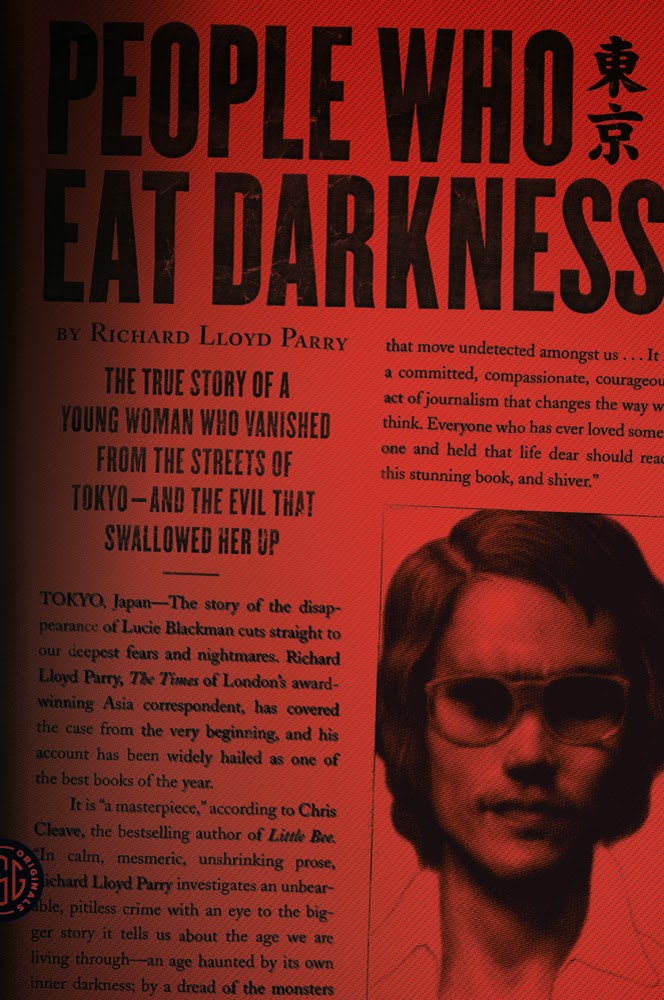
 9. People Who Eat Darkness by Richard Lloyd Parry. (05/2012) True Crime Non Fiction. It is based on the true events about the disappearance of Lucie Blackman, a girl from the UK who goes to Japan and works in those restaurants where girls sit and chitty-chat and pretend to be a "girlfriend" without the sex. Parry goes to Japan to cover this story and it is so engaging because not only it involves Japan and their strict customs, but Blackman's psychotic family as they storm to Japan and try to figure out something. The killer is a grade A psychopath that makes Ted Bundy look like a pansy.
 
 8. Safe Haven by Nicholous Sparks. (12/2012) Contemporary Romance. If you want a safe romance (no in-depth sex scenes) with a thriller twist, here it is. I don't normally read his books because they are just so, boring. But this one was different. After killing her husband in self defense, she runs away to Safe Haven to start over. She meets a single dad who owns the local bait and tackle shop. Life is good and she's settling in when suddenly a stalker comes what seems like out of nowhere to track her down. Who is this guy? Someone you'll never expect. There are two great surprising twists in this story.
 
7. The Origami Yoda Series by Tom Angleberger (The Strange Case of Origami Yoda, Darth Paper Strikes Back, The Secret of the Fortune Wookie, Surprise Attack of Jabba the Puppet, Princess Lablemaker to the Rescue). (2010 - 2014) Middle grade children's chapter book. Want a super nerdy fun read? This is it! A bunch of loser guys at this school comes together and with the power of origami Yoda, they win (not really) the day. Too funny!

6. Below Stairs by Margaret Powell. (12/2012) Biography. The true accounts of the maid who inspired Upstairs Downstairs and Downton Abbey. Wonderful little biography. She was a fascinating woman herself. I did a blog review last year after I read it. 
 
5. An Angel for Christmas by Heather Graham. (10/2012) Paranormal Romance. Nothing gets Christmas started best like when a dysfunctional family finds a bleeding cop facedown in the snow in their driveway. Who is this guy? Is he really a cop? but here's a crazy murderer causing havoc. She falls in love with the cop, but is he real or a ghost tangled in an ancient war between good and evil? This book is very rated G. The only "oh!" moment is the mention of a shower and she's wearing a towel in the hallway. Oh my!

4.The Aisling Grey Guardian Series by Katie MacAlister (You Slay Me, Fire Me Up, Light My Fire, Holy Smokes). (2004 - 2007) Paranormal Romance. This will make you spit milk from your nose because it is so damn funny. Aisling finds out the hard way that she is a mate to a dragon, not just any dragon, but the king of thieves, who loves shineys...much more than her. Throw in a cast of weirdo paranormal misfits, a demon reject as her sidekick, and a creepy taxi driver who shows up in every country she goes to, you have a wacky adventure. I could not stop reading it, it was so funny. Sex scenes are not pornographic, but there's biting.

3. Tiger Lily by Jodi Anderson. (07/2013) YA fiction. Ever wondered about Tiger Lily from the Peter Pan stories? Anderson brings a fantastical, gruesome, realistic, spin the the life of the people in Tiger Lily's village, and who Tiger Lily was to Peter Pan. I enjoyed it because it talks about how when we destroy a person, we really destroy people. If you know who the Zuni Berdaches were, then it would make sense, but regardless, your heart will ache in this story. It was beautifully written. No sex, but it hints to a rape.
 
 
2. The Enchanted Life of Adam Hope by Rhonda Riley. (04/2013) Fantasy/Fiction. A beautiful love story about a woman who digs a strange creature out of the mud during a storm in 1950s midwest. This creature slowly becomes woman, then into a man. And they embark on one of the most sweetest love stories I have read in a long time. It is WEIRD, but beautiful. Has mild sex scenes and drug use (during the 70s).
 
1. The Black Jewels Trilogy by Anne Bishop (Daughter of the Blood, Heir to the Shadows, Queen of the Darkness). (1998-2000) Dark fantasy/Horror. For me, there will NEVER be a better trilogy of books written in MY lifetime. This was one of the few books that have left me so empty, I cried because I didn't want it to end. To me this is the epitome of what dark fantasy/horror should be. Welcome to a miserable world where the dark has been skewered by those with no power, through blood packs with the Lord of Hell's wife (whom he is divorced from), the "humans" have enslaved those with power, mostly men who have the power of the Jewels, to meager slaves, robbing them of their pride and sanity. They hinge on one hope that the "Queen of the Darkness" will be born and bring order and peace again. It's really a story about a father who has been torn from his sons. As the future queen is born, the Lord of Hell goes through "hell" to bring her to him, especially when he finds out she is being tortured as a child by family who think she's crazy. The young girl, meets her "mate", who is a slave. He gives his life to protect her and enters a shattered realm of madness to save her soul after she is brutally raped and killed. Knowing that his mind is going, he shatters his jewel to call his father (Lord of Hell) and his half-brother (another slave in a distant land) to take her and keep her safe. Recovering, she joins her "blood father" (Lord of Hell) and she grows into a Queen to be feared and adored. She frees her mate from the bowels of insanity and together they rage war, with her new kingdom. Gorgeous book, and I cried like a baby at the end. Bishop wrote one of the best "goodbye" scenes I have ever read. WARNING: This book if not for the faint of heart. There is rape (towards men), child rape, child prostitution, slavery, torture (like you cannot imagine), burning, and "bitch" is used quite often. Book 1 is brutal, B2 is much calmer as the Queen grows up, going to the point of cute and funny, a nice break from the horror of B1. Book 3 is rough, but not as bad as Book 1.

Now go out and READ!